
PUBLICATION
Bauxite
Published: 2023-2-25
Researcher(s): Karen Vermeren
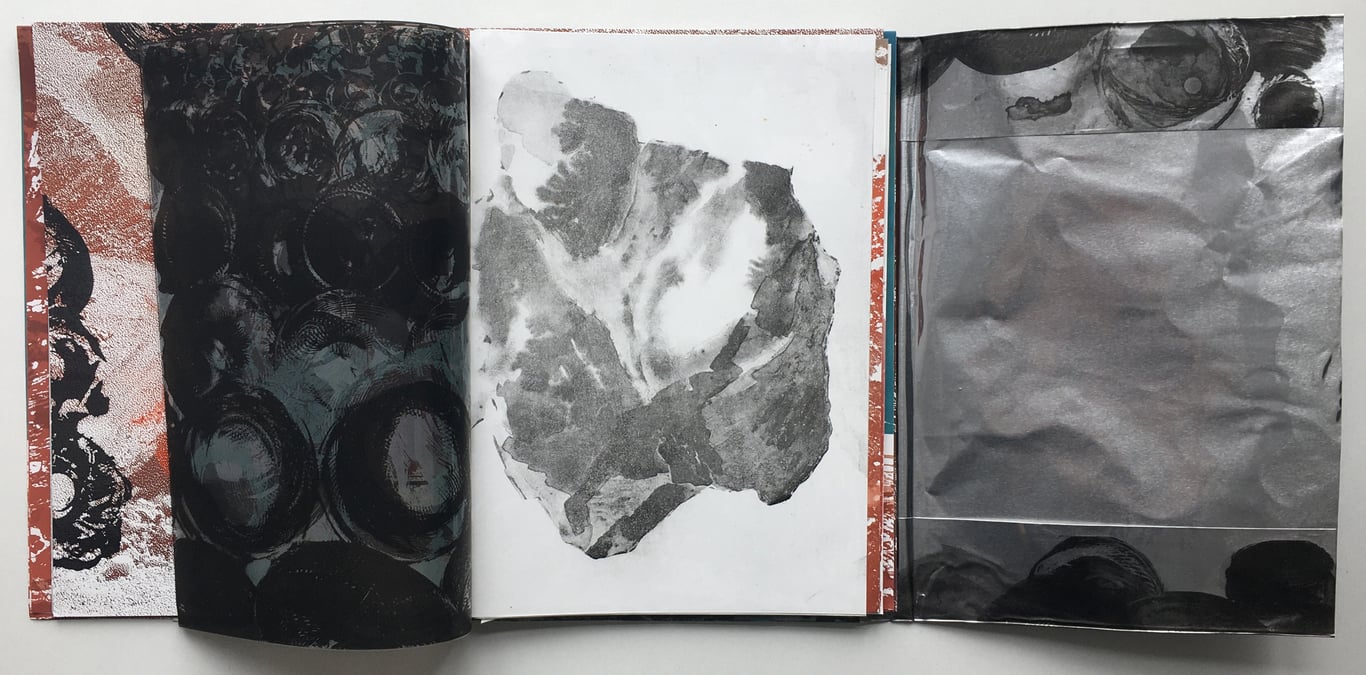
Bauxite, an edition with & on aluminium, stone paper & plastic, made by SLARG researcher Karen Vermeren during her artist in residency in Masereel Center and with an accompanied text from Sofie Crabbé, is the start for her research project City in Reverse, Reflecting Aluminum.
"The shaping of the landscape – often, it is a natural process, while sometimes the human hand intervenes, which is the case in the extraction of raw materials. Inquisitive about the source, researcher and visual artist Karen Vermeren headed in 2018 to Rudnici boksita Nikšić, a mine in Montenegro known as one of the largest bauxite reservoirs in Europe. Bauxite is a sedimentary rock formed by millions of years of chemical weathering. It consists of several types of ore minerals, including hydrated aluminum oxides. As such, Bauxite is the main source for the extraction of raw aluminum. The mining of bauxite impacts the landscape. Gaping cavities and pockmarked hills marred by the excavation of blocks of ore appear. Stones in various shades of reddish brown and gray come to the surface. And transport routes wind their way through the battered open site.
A love of the landscape in change and the processes that shape it resonates throughout Vermeren's artistic practice. The artist likes to explore it, wander around in it, observe the (effects of) natural forces, such as the melting of a glacier, the formation of ice columns in a cave, the shifting, colliding, and crashing into each other of tectonic plates, and the mountains and volcanoes that arise from it. For her artist's edition Bauxite, she went to live in a geological landscape that evinced traces of active human forces, namely a mining terrain. Deep grooves make passersby aware of the excavation of bauxite on or just below the thin, outer shell of the Earth. Vermeren's panoramic images and details invite a careful contemplation of the delicate colour planes, the wavering interplay of lines, and the grainy texture. Sometimes she highlights fragments of the processing of bauxite into aluminum. Painted, silver-coloured, gyrating movements, for example, refer to aluminum coils. They capture the moment just before the industry cuts the aluminum and makes it usable for a wide variety of applications. The silkscreen of a vermillion surface is striking. Among other things, it is reminiscent of red mud, a waste product whose recovery takes five to ten years. It not only looks toxic, it ís also toxic. It contains toxic metals and can cause burns after prolonged exposure. Although it is not Vermeren's initial intention, in this work, the artist also exposes economic mechanisms such as capitalism and the exploitation of natural resources. Driven by monetary gain, the gaze is often averted from their harmful impact on the environment and surroundings.
The handling of carefully selected, often transparent materials is another important recurring element in Karen Vermeren's visual language. My hands glide over the aluminum casing of the artist's edition Bauxite. It feels somewhat cold, yet at the same time it is light. In a smooth motion, it opens up to reveals a multitude of prints, folded alternately horizontally and vertically. They are works of art in themselves. My fingers flip through the prints. They are alternately printed on soft stone paper or on thin plastic. The materials colour the tactility and reading experience. I carefully unfold the prints. Some are as large as roadmaps. A childhood memory takes hold of me. I see my father leaning forward at the dinner table, his gaze scanning the map of France and his index finger mapping out the road trip for the summer vacation. For a moment, I draw a line between the two quests, each with their own purpose – from bauxite, indispensable in the production of aluminum, to the sunny travel destination of the family.
The different materials of this artist's edition also affect its readability. The plastic is printed on both sides. The transparency inherent to the material causes the prints to overlap. The somewhat denser stone paper allows the recto verso prints to shine through more subtly, aided by the presence of a light source.
Finally, there is also Karen Vermeren's intense dedication to various visual media with which she experiments. In the making of her creations, the artist engages with drawing and painting as well as photography, installation, and graphics, including all possible crossovers. For Bauxite, the artist used three graphic processes on different carriers, as described above: screen prints on stone paper and plastic, stone prints - also known as lithographs - on stone paper, and offset prints of images of aluminum coils on aluminum. The latter printing technique ironically also involves an aluminum printing plate. The triple reference to aluminum enhances the strength of the work. At various stages in the graphic process, Vermeren drew and painted on the image with silver and black ink or acrylic paint. In addition to the manually made, partly uncontrollable prints, the combination of pictorial additions and omissions – such as colours or lines that have been slightly moved, accentuated or softened to a greater or lesser degree – enhance the unique character of each artist's edition. Movement, change and surprise flow through the heart of this gem." Sofie Crabbé