EVENT
Public Doctoral Defense Sammy Baloji (hybrid event)
You are warmly invited to attend the PhD defense of Sammy Baloji:
Contemporary Kasala and Lukasa: Towards a Reconfiguration of Identity and Geopolitics
This is the program:
14:00 — Exhibition visit
15:00 — Public defense
17:00 — Reception
Supervisors: Ruth Loos (Sint Lucas Antwerp), Bambi Ceuppens (AfricaMuseum), and Paolo Favero (University of Antwerp)
Please register HERE.
You can also attend via this online link:
Baloji is inviting you to a scheduled Zoom meeting.
Topic: PhD Public Defence Sammy Baloji
Time: May 18, 2026 03:00 PM Brussels
Join Zoom Meeting
https://us06web.zoom.us/j/83172765545?pwd=0sv2PqsrofY9CK9HSuWWXD30d6UGNV.1
Meeting ID: 831 7276 5545
Passcode: 964027
About the research
With Contemporary Kasala and Lukasa: Towards a Reconfiguration of Identity and Geopolitics, Sammy Baloji presents an artistic PhD situated at the intersection of visual art, history, and visual anthropology. The project departs from two mnemonic practices used by Luba communities in the Democratic Republic of Congo: the kasala (a ceremonial, performative form of poetry) and the lukasa (a tactile memory board used in ritual contexts).
By rethinking and reactivating these forms, Baloji develops new artistic “memory devices” that respond to the fractures produced by colonial border-making between the regions of Kasai and Katanga. The research raises critical questions about identity and geopolitics: how can artistic practice contribute to dismantling national narratives shaped by colonial boundaries? And how might contemporary identities draw from precolonial knowledge systems and histories of migration as a way of imagining futures?
The dissertation unfolds as a hybrid constellation of artistic production, historical inquiry, and critical reflection, structured across several chapters and accompanied by an extensive handbook of images and documentation.
Chapters
The introductory chapter reconsiders concepts such as land, territory, soil, and community from both Luba perspectives and European colonial epistemologies, establishing the conceptual framework of the research.
“Missa Utica” (Chapter 1) focuses on the creation of a musical and performative work. Drawing on the history of the Kongo Kingdom and its exchanges with Portugal and the Vatican from the 15th century onward, Baloji explores how kasala and lukasa can operate as contemporary narrative instruments. The chapter also reflects on the challenges of transdisciplinary collaboration and the political dimensions of artistic production within Congo and in international contexts.
“Extracted Resources, Transformed Matter” (Chapter 2) examines the impact of extractive economies—from colonial exploitation to contemporary resource politics—on both material and cultural forms. Projects such as Style Congo. Heritage & Heresy (2023) and Aequare. The Future That Never Was (2023) serve as key case studies, revealing the entanglement of economy, aesthetics, and history.
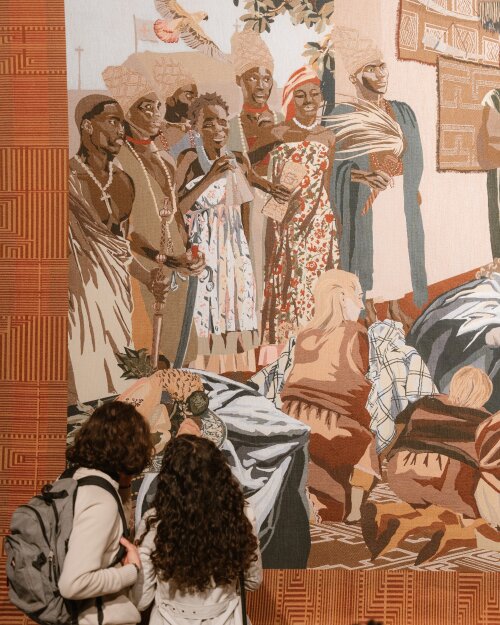
In “Deconstructing Boundaries and Narratives” (Chapter 3), kasala-based storytelling becomes a method for reworking dominant historical narratives. Works such as The Long Hand (2022), Le fil sucre-pourpre de Mulohò (2024), and L’Arbre de l’Authenticité (2025) form a trajectory in which borders, memory, and imagination are critically reconfigured.
Context
The defense takes place in the context of Baloji’s exhibition Copper thread, Rubber thread, Sugar thread (17.04.26 – 16.08.26) at Kunsthal Extra City, where several strands of the doctoral research are brought together spatially and visually.